
How to Use Breathwork to Improve Sleep Quality: A Step-by-Step Guide
For many of us, sleep has become something we chase rather than something we simply fall into. With minds cluttered from the day and bodies still holding the energy of stress or stimulation, it's no surprise that so many people lie awake at night, struggling to find rest.
But sleep doesn’t have to be elusive. One of the most natural, effective tools to improve your sleep is something you’re already doing — breathing. Breathwork, the conscious practice of regulating your breath to influence your physical and emotional state, offers a gentle, non-invasive way to support your nervous system and guide yourself into deeper rest.
In this guide, you’ll learn how to use breathwork to improve sleep quality through a series of simple, progressive practices that you can begin tonight. Whether you experience insomnia, restless sleep, or simply want to deepen your evening wind-down, this step-by-step approach can help you reconnect with your body’s natural rhythms and sleep more peacefully.
Why Breathwork Supports Better Sleep
Breath and sleep are intimately connected. When we breathe in a slow, steady, and conscious way, we send signals to the brain that it’s safe to relax. The nervous system responds by shifting from sympathetic activation — the state responsible for alertness, stress, and high energy — to parasympathetic activation, the state associated with rest, digestion, and repair.
Most people go to bed still operating from a sympathetic state. Even if the body feels tired, the mind continues to race. Breathwork slows the internal tempo, lowers the heart rate, and reduces cortisol levels, creating a biological and emotional environment that welcomes sleep.
Incorporating breathwork into your nighttime routine trains the body to enter a relaxed state more easily. Over time, these techniques can help reset sleep cycles, improve sleep depth, and even reduce nighttime awakenings.
Creating an Evening Space for Stillness
Before beginning your breathwork practice, take a few moments to prepare your environment. Dim the lights to let your body know it's time to wind down. Turn off digital screens or switch them to night mode. You might want to light a candle, diffuse a calming scent like lavender, or put on soft ambient music. Make sure you’re comfortable—lying on your bed or a soft surface with your body fully supported.
Creating a ritual space for breathwork signals to your mind and body that you are transitioning into rest. This small act of intention can deepen the effects of the practice itself.
Step One: Begin with Coherent Breathing
Coherent breathing is a gentle, rhythmic breath pattern where the inhale and exhale are equal in length. It’s a foundational technique that harmonizes the breath with the heartbeat and encourages the entire nervous system to move into a state of coherence.
To begin, inhale slowly through your nose for a count of five or six. Then exhale for the same length, keeping the breath smooth and quiet. The goal isn’t to force deep breathing, but to settle into a steady, balanced rhythm. Imagine your breath moving like ocean waves, flowing evenly in and out.
Continue this pattern for three to five minutes. As you breathe this way, notice how your thoughts begin to slow and your body starts to soften. Coherent breathing sets the stage for the deeper techniques that follow.
Step Two: Deepen Relaxation with 4-7-8 Breathing
Once your breath feels settled, you can introduce a pattern that further calms the mind and lengthens the exhale, which is key to slowing the heart rate. The 4-7-8 breath is often used as a natural tranquilizer for the nervous system.
To practice it, inhale gently through your nose for four seconds. Hold the breath for seven seconds. Then exhale slowly and completely through your mouth for a full count of eight. Repeat this cycle for four rounds, or more if it feels good.
The extended exhale is particularly important. It signals to the brain that you’re safe, which turns off the body’s stress response. With each breath cycle, the body moves more deeply into stillness. Many people find that this practice alone is enough to help them fall asleep, especially if their difficulty comes from a restless or anxious mind.
Step Three: Use Breath to Scan and Release the Body
After practicing 4-7-8 breathing, it can be helpful to pair the breath with a body scan. This invites a sense of presence and encourages full-body release. Rather than rushing into sleep, the body gently softens, layer by layer.
Start by bringing your attention to the top of your head. As you inhale, simply notice that area. As you exhale, imagine that part of your body relaxing and sinking downward. Move your awareness slowly from the crown of your head down to your forehead, jaw, neck, shoulders, chest, and arms. Continue through your torso, hips, legs, and feet.
With each breath and each exhale, visualize tension leaving the body. Let your awareness rest briefly on each area before moving to the next. This process does not need to be exact or mechanical. Think of it as a gentle exhale-led journey down through your body. By the time you reach your feet, it’s common to feel fully relaxed—or already drifting into sleep.
Step Four: Add Alternate Nostril Breathing (If Needed)
If you’re someone who experiences racing thoughts at night or tends to carry mental tension into the evening, alternate nostril breathing can bring balance and mental clarity. This ancient yogic practice is known for regulating the flow of energy through both hemispheres of the brain.
Sit or lie down in a comfortable position. Gently close your right nostril with your thumb and inhale through the left nostril. Then close the left nostril with your ring finger, release the thumb from the right nostril, and exhale through the right. Inhale through the right, switch nostrils, and exhale through the left. Continue in this alternating pattern for a few minutes, breathing slowly and evenly.
This technique is optional, but it can be very supportive on nights when anxiety or mental overactivity is keeping you awake. It restores a sense of balance and calm, both mentally and energetically.
Step Five: Close with a Breath and an Intention
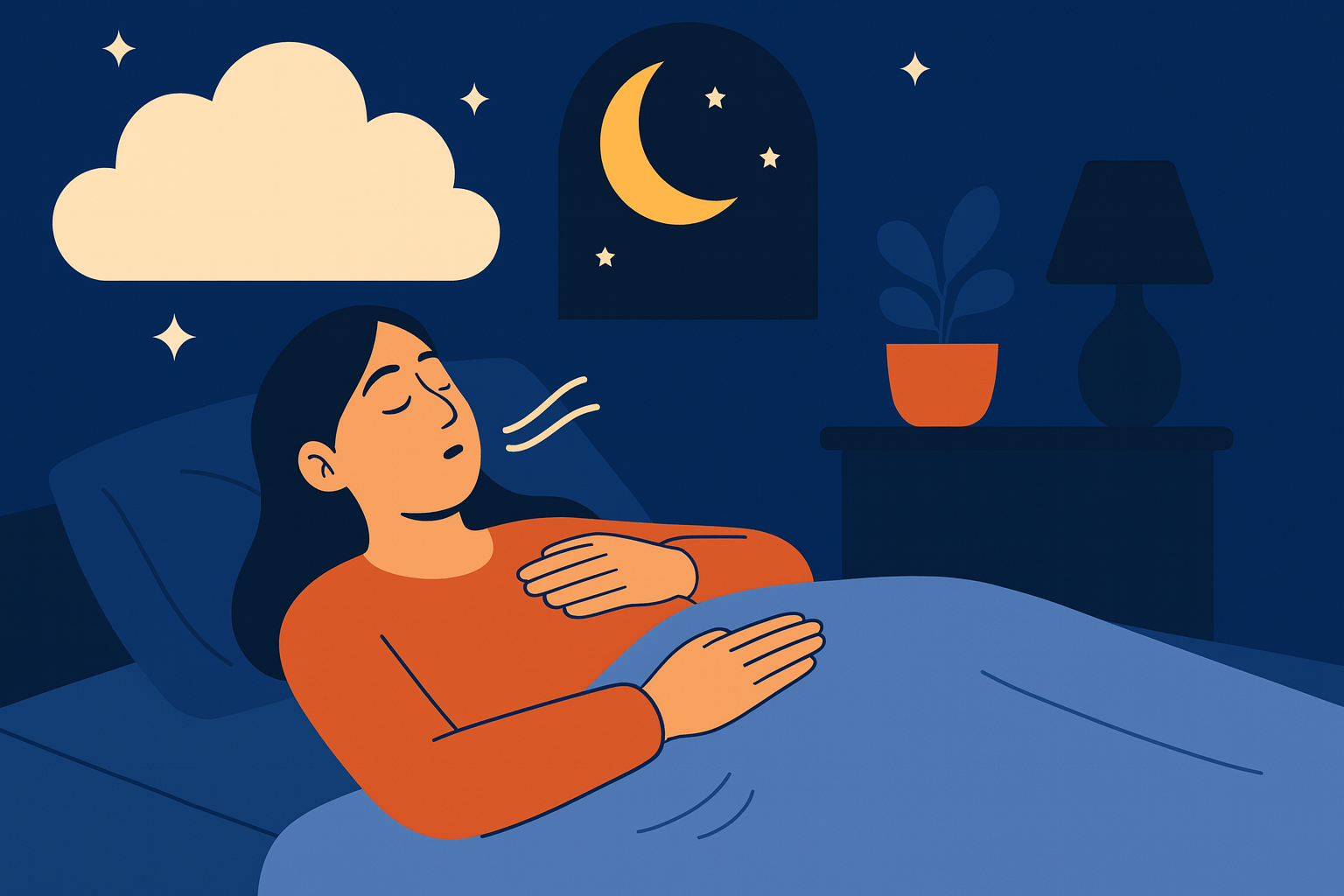
To complete your breathwork for sleep, place one hand on your heart and one hand on your belly. Breathe naturally and feel the gentle rise and fall. This is a moment of integration—a quiet pause to seal your practice.
You might choose to mentally repeat a calming phrase as you exhale, such as “I am safe,” “I allow myself to rest,” or simply “Let go.” These words, paired with the breath, become an inner lullaby that tells your body it’s time to surrender.
Let your breath return to its natural rhythm. If sleep has not already arrived, it likely will soon.
Over Time, the Breath Becomes Your Sleep Ally
The effects of breathwork are both immediate and cumulative. Many people feel calmer after just one night of practice, but the true benefits unfold with consistency. As you continue to use breathwork in the evenings, your body learns to associate these techniques with rest and safety. The breath becomes a gentle signal, telling the body it’s time to let go.
Some nights you may complete the full practice. Other nights, you might fall asleep midway through your first technique. There’s no need to “finish” anything. Breathwork is not a task; it’s a returning. A way of coming home to the quiet within.
Final Thoughts: Sleep as a Sacred Surrender
Breathwork reminds us that sleep is not something to force, but something to allow. In a culture that values productivity and stimulation, it takes courage to slow down, soften, and truly rest. But your body knows how. Your breath knows the way.
Each inhale is a beginning. Each exhale, a release. And between them is the space where rest is born.
Tonight, instead of fighting sleep, try following the breath. Let it carry you from tension to tranquility. From wakefulness into deep, healing slumber.